
Telling Stories with Your Assets
Every asset we make feeds into the game's narrative. This includes the most mundane elements we don’t pay special attention to - but which say a lot about society at the same time.
Ibru is no exception. The city might be ruled by gods, but the vast majority of its inhabitants are humans and Ardent, and they need a way to transport goods and themselves across the city-state. There are three solutions: Using the fixed lift system connecting the city, walking to your destination, or crossing the winding streets of the city.
However, designing a vehicle to navigate the confines of the divine city must also reflect the greater lore and logic of the gameworld. A vehicle must:
Reflect the absence of open flame and fire, decreed by the gods to protect the city and its denizens from harm.
Be able to convincingly navigate the narrow streets and steep stairs that link the city together.
Show Equitech's product philosophy: Cheap, bulky, and decidedly user-unfriendly items for use by the general population in the middle and lower classes.
How do you build a vehicle fit for the purpose?
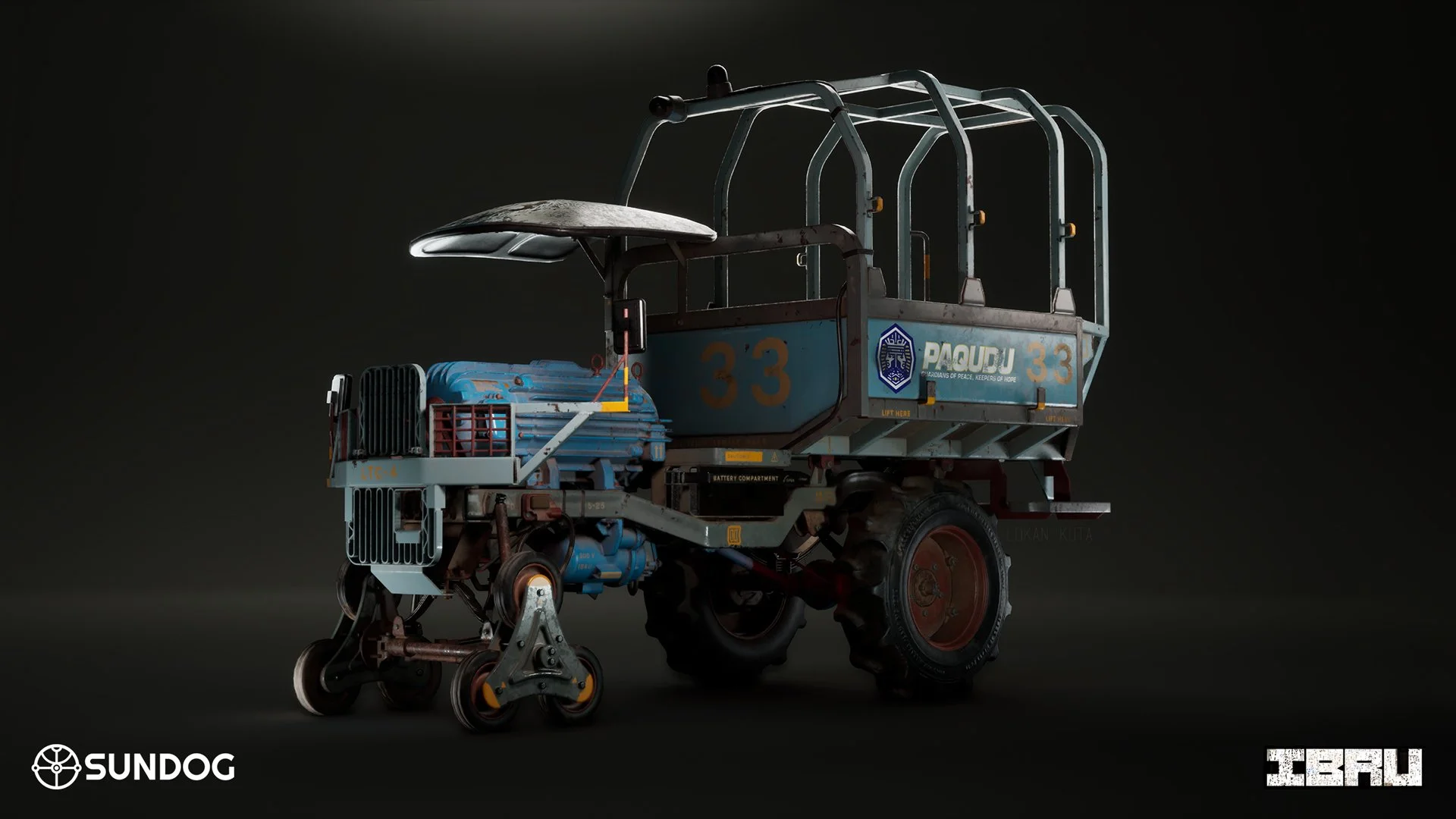
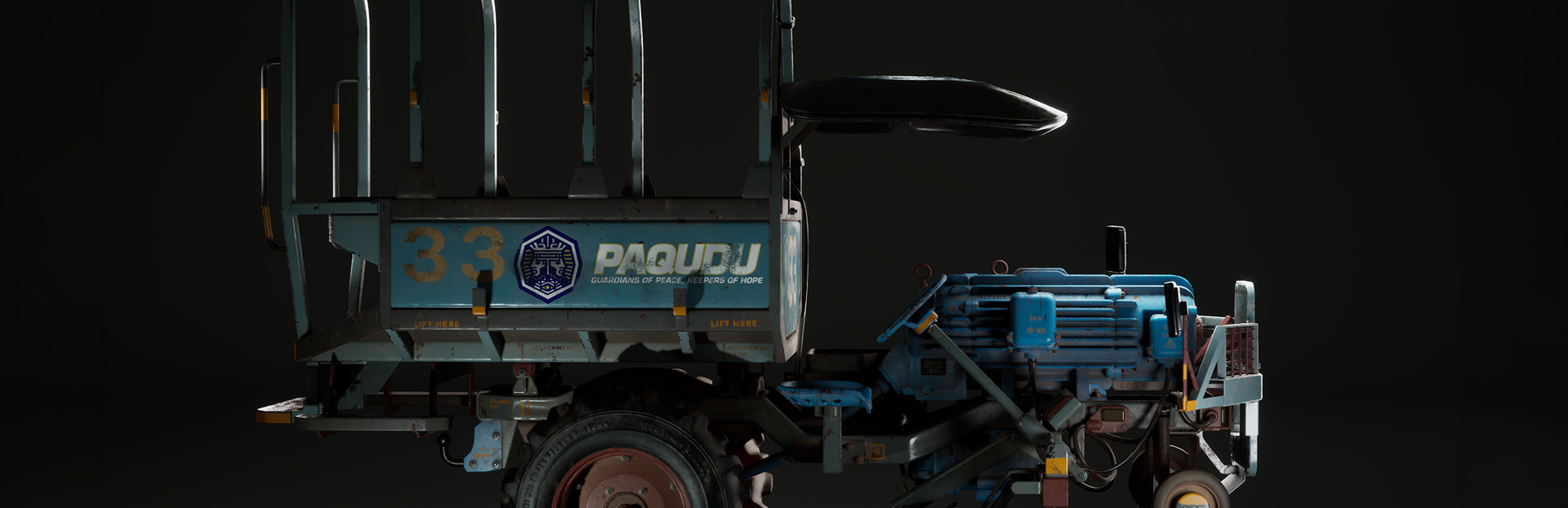
Modeled by Lokan Kuta, the universal tractor is inspired by mid 20th-century designs like Unimogs and two-wheel tractors - where form followed function. Additional inspiration came from historic examples of early industrial societies meeting the need for transportation - most importantly the auto rickshaw or tuk-tuk - except with a lot more torque and power to help it climb the steeply angled stairs across the city.
The tractor is a modular design built around a powerful industrial electric motor, with the driver sitting right next to the beast protected by only the front cage and an overhead roof to keep out Ibru’s merciless sun. A simple leaf spring suspension mounts the powered rear wheels onto the rigid ladder frame, with steering wheels on the front that also allow it to climb stairs with ease.
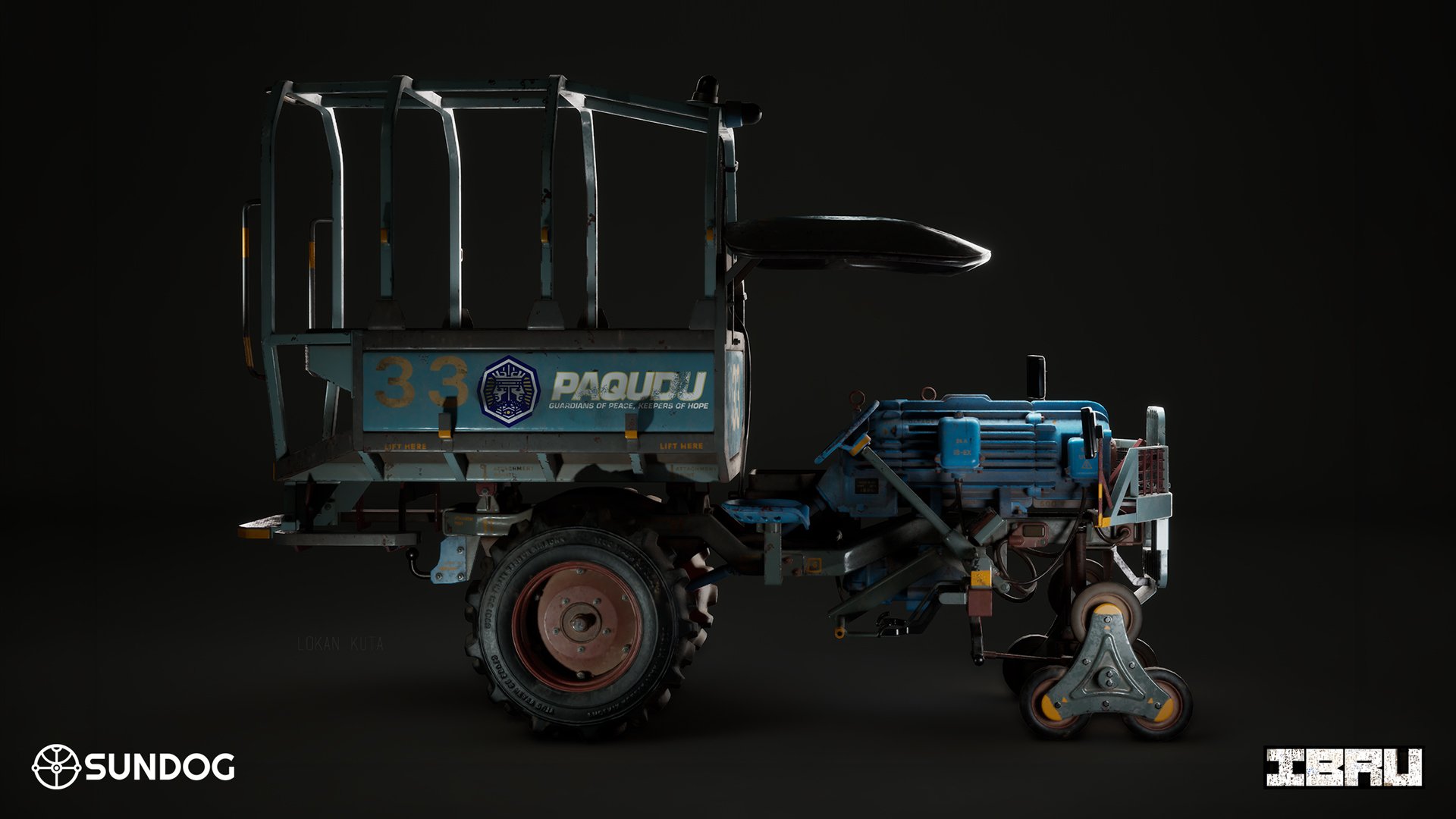
Every aspect of the tractor is designed to make it as rugged as possible, while keeping the costs low. There’s no extra bodywork or decorative components, just a mercilessly functional design that’s all about function.
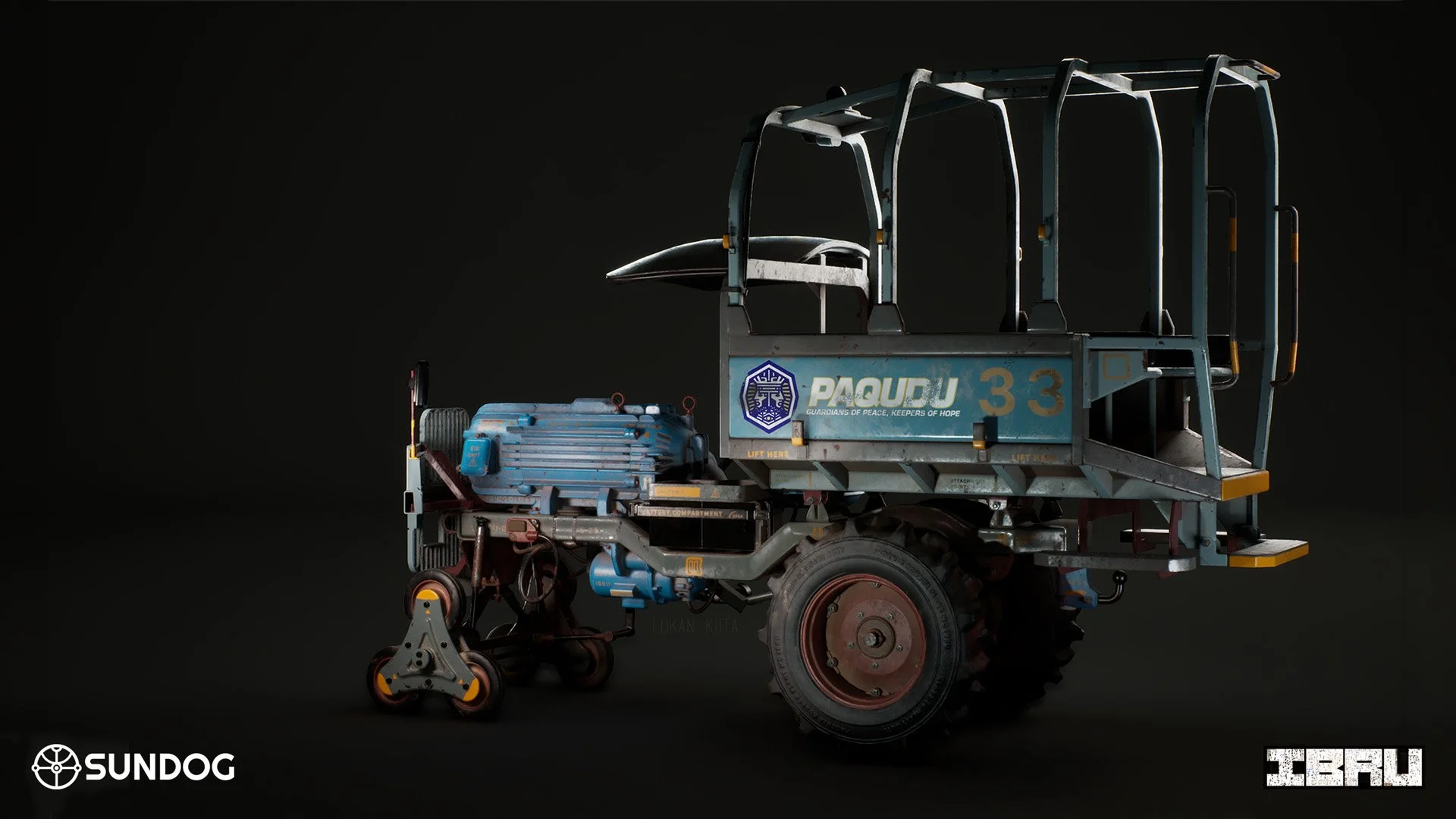
Its flexibility is virtually unlimited, thanks to the modular design and wide availability of different rear elements, including a cargo bed, cistern, a vendor module, and a passenger section seating six in bearable discomfort (with a military-style roll cage added to protect the Paqudu, as seen on the one in the teaser).
Implementing InteGra

InteGra is one of the principal unique selling points of Ibru, a comprehensive system that models the player character’s personality based on their behavior and adjusts the game in real time.
We have already introduced the general principles of the system we are developing together with SWPS, and it’s time to break it down: How will it actually work? How will player choices impact the psychological model? How does it differ from how other RPG games model reactivity to increase immersion?
What’s in a model?
The player’s behavior is tracked by InteGra in real time using a personality model: Instead of isolated decision points that result in infrequent, but significant changes, it takes into account the entire behavior of the player’s character: What they say in dialogue and how they behave towards other characters, how they tackle the gameplay challenges, how they handle their cases and which conclusions they draw…
As a result, the aggregate effects of player character’s behavior create a constantly evolving personality model. InteGra then uses this model to alter the game, such as by modifying the player character’s responses to match their personality: Consistently using aggressive solutions and engaging in such behavior produces a detective that is direct, brusque, even a little hostile in his interactions with others - while a more cerebral, analytical approach will make him interact with the denizens of the city of gods in a more reserved, calm manner that may help potential perps incriminate themselves.
Players are not locked into a specific personality either: The goal of InteGra is to provide a more nuanced solution to the problem of ludonarrative dissonance by matching the options given to the player in e.g. dialogue to the personality of the character they roleplay.
This also includes covering cases where the character’s behavior changes as players experience the story. Instead of choosing between alternatives that no longer match their character’s personality, InteGra provides individualized options based on the personality model.
Where InteGra comes in
Every game is fundamentally limited in its ability to individualize the gameplay experience: A writer can only create so many variants of a single dialogue line, much less entire dialogues; a designer cannot build an infinite number of variations of character behaviors and reactions. As otherwise the scale of individualization grows exponentially, both make necessary assumptions and approximations of player behavior while creating the game.
InteGra is designed to make this both manageable and practical. Rather than rely exclusively on complex webs of scripts, flags, and variables, necessitating an individualized solution for every game, InteGra provides a single, scalable system that collects information about players’ choices, actions, and general behavior within the game and feeds it into the game as usable data.
As a result, instead of an abstract alignment system that accounts for a specific set of decisions - such as whether the player behaved in an aggressive, noble, or pragmatic manner in dialogue - an InteGra-enabled system can track the full spectrum of player behavior, from general behavior towards the world and its inhabitants to mechanics used, allowing for much finer modeling of player behavior and more individualized design.

Paqudu: The Long Arms of Fatherly Justice
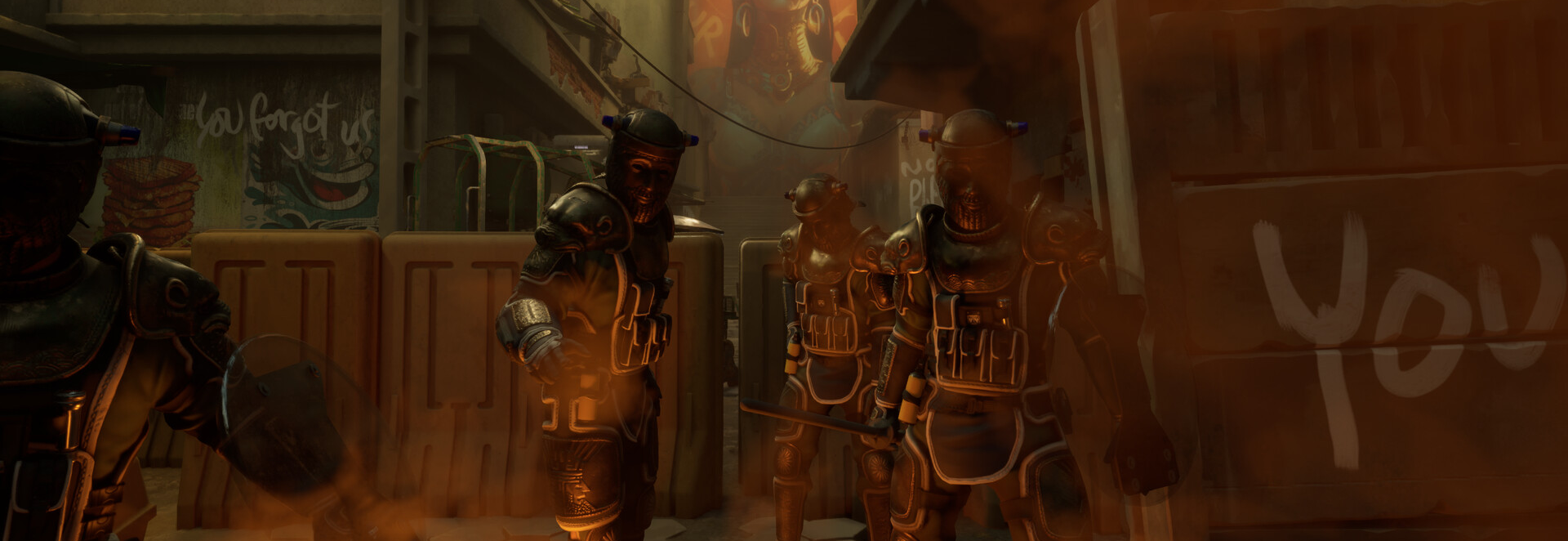
“Guardians of Peace, Keepers of Hope”
Every society needs some kind of order to survive. Some do it voluntarily, others require coercion... Up to and including violence to keep the underclasses in line.
Who keeps the people in line in a city ruled by gods?
The Paqudu.
They serve a vital function, keeping the city's social structure functioning through a combination of intimidation, investigation, and when necessary, violence.
Controlled by the divine Isimud through the Ministry of Serenity, they are the long-reaching arm of the Fathers' justice - or what passes for it in the shadow of the ziggurat.
Opinions on the Paqudu range from the enthusiastic to the downright hateful, depending on where you live.
To the affluent denizens of Zal-Antagal, they are the necessary wall separating them and their wealth from the unwashed masses below.
In the slums of Kug Nansha, they are seen as the nightstick of the Fathers, keeping the underclass from knocking over the social ladder of the forever city.
Some are more equal than others
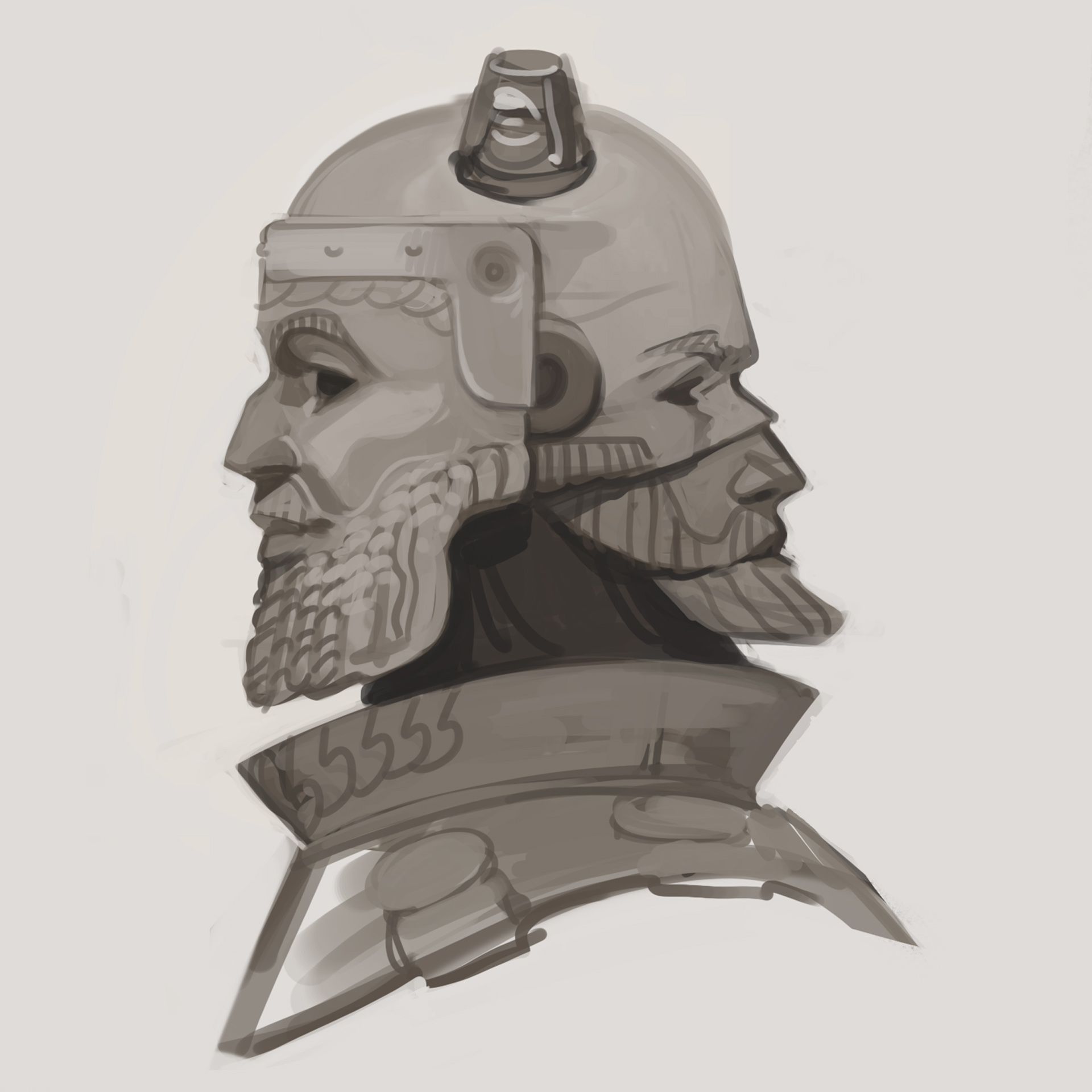
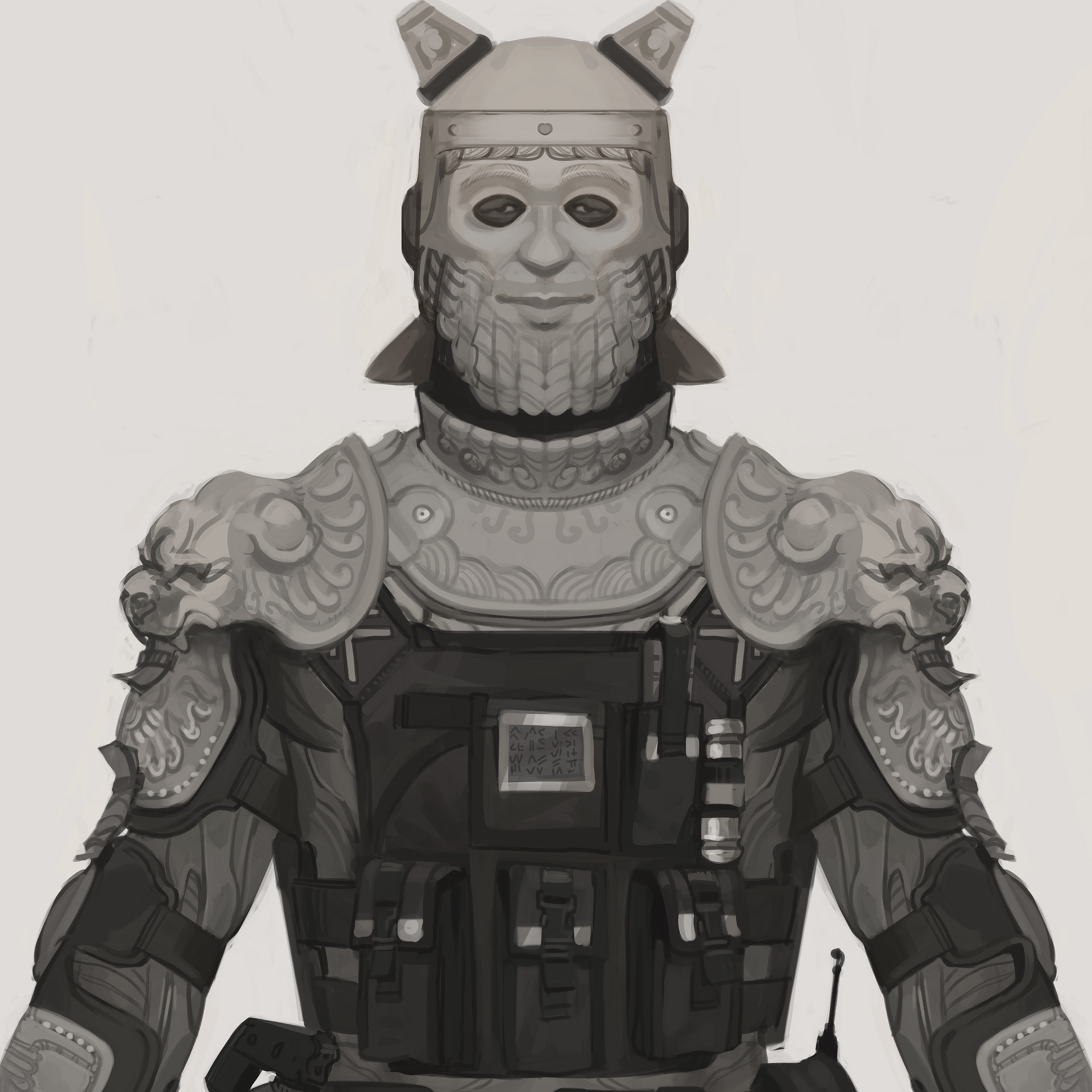
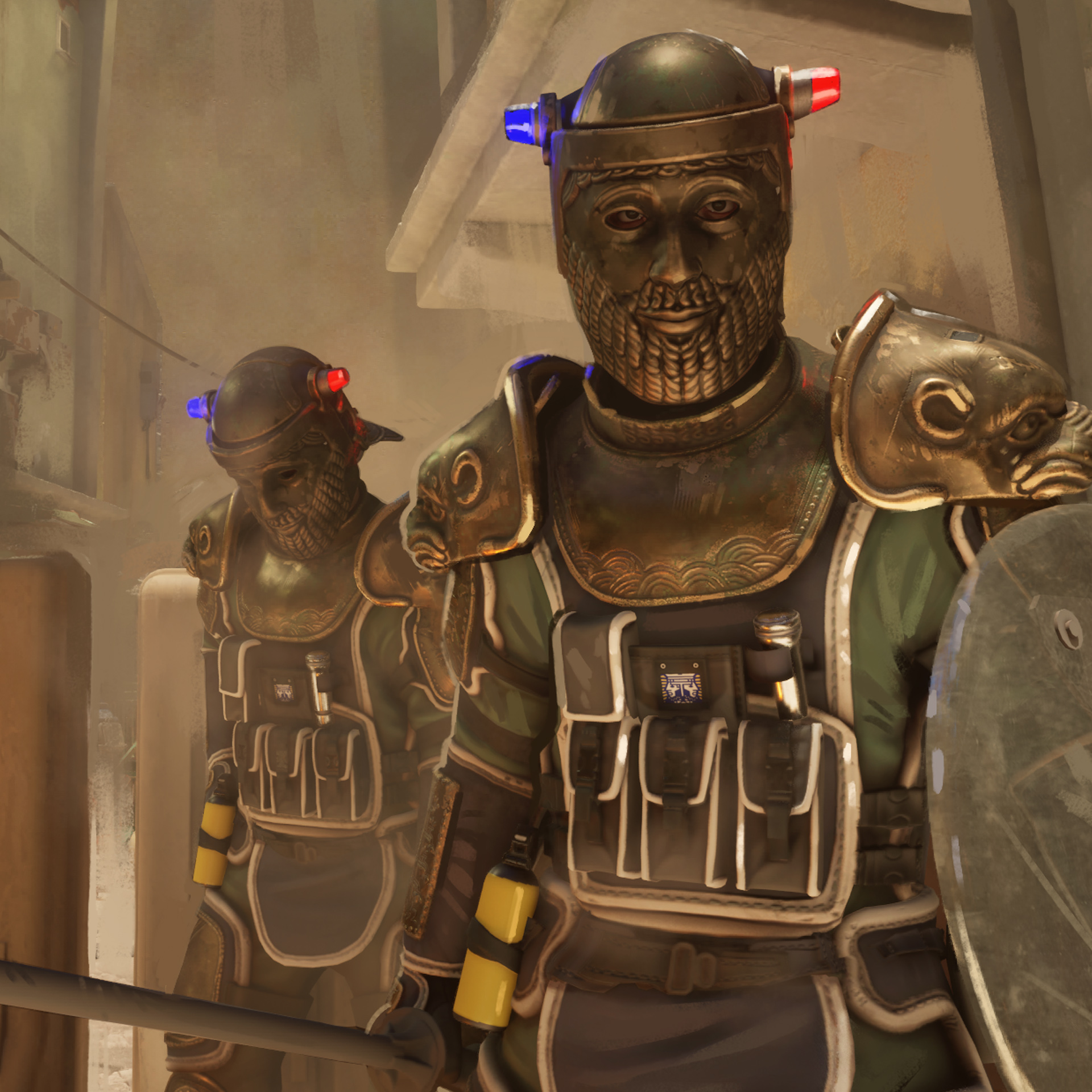
Those keeping what passes for peace are, in fact, largely an underclass themselves. Most of the rank and file are "dollfaces", Ardent manufactured from life-giving clay and imprinted with just enough intelligence and skill to enforce the existing laws without questioning them.
Born humans take care of everything else, from investigations to bureaucracy, although the Fathers have decided to use a select batch of Ardent for special investigations.
At their best, the Paqudu keep the peace and prevent Ibru from sinking into chaos.
At worst, they keep turning the handle, grinding Ardent and human alike into fine dust.
Who were the historical paqūdu?
The historical paqūdu were a Sumerian police-like force that existed in Mesopotamia between the sixth and fifth centuries BCE, formed as the ancient realm experienced an unprecedented economic prosperity and increasing social complexity. Archeological evidence attests to their existence across the ancient empire, including its largest cities: Uruk, Babylon and Sippar.
Offices of the paqūdu were established both in great cities and smaller towns, carrying tasks we associate with the police nowadays: Surveillance, law enforcement, apprehension of criminals etc. They were also used by temples for enforcement, subordinated both to the priesthood and to local authorities, occupying a lesser, but necessary rung on the social ladder.
Interestingly, the idea of a dedicated law enforcement force did not disappear with the conquest of Persia by Alexander the Great in 4th century BCE, but spread. Similar organizations appeared in Egypt of late antiquity and the Graeco-Roman era, like the eirenarchai (peacekeepers).
What’s InteGra?
InteGra is currently under development by Sundog, closely tied to our upcoming RPG, Ibru. But what exactly is it? How is it supposed to work? And how does it relate to Ibru?
What is InteGra?
InteGra is a Research and Development (R&D) project carried out under the European Funds for a Modern Economy (FENG) program. Our focus is on creating a system that supports narrative design in video games by modeling player character behavior patterns. Its first real-world implementation will be right here in our studio’s first game, Ibru.
The project is being developed in stages alongside an interdisciplinary team of experts from SWPS University, the University of Warsaw, and the Wrocław University of Science and Technology. The Polish Agency for Enterprise Development (PARP) oversees the project's execution, managing the EU grant funds based on Sundog’s progress reports.
What is InteGra’s goal?
The goal is to push the level of immersion. By modeling the player character’s personality, we can create more cohesive dialogue and adapt the tone of interactions to match the player's actual playstyle.
In traditional narrative systems, decisions are the main driver: every choice has a consequence, but those choices are often isolated from one another. This frequently creates narrative dissonance, where different characters make the same choices and experience the same consequences, regardless of the player's overall behavior.
InteGra is being developed to achieve narrative consistency by modeling the character’s psyche based on their total behavior, not just a isolated forks in the road.
How does InteGra model player behavior?
InteGra analyzes how you act throughout the game to build a psychological model of your character. This model is then used to e.g. adjust your character’s speech patterns and the reactions of NPCs. With InteGra, the game will respond differently to a confrontational attitude than it would to an empathetic, pragmatic, or analytical one—moving far beyond current industry standards.
The ultimate aim is maximizing narrative cohesion. Players shouldn’t have to settle for dialogue lines or actions that only "sort of" fit the character they’ve built. The game dynamically adjusts available choices to reflect the player’s character as accurately as possible.
Is InteGra an AI/LLM?
No. InteGra is not an "artificial intelligence" in the sense of a system meant to generate narratives or dialogue without a human creator. The script, the world, and the content itself remain under the exclusive control of the writers. We’ll explain the specific role LLMs play in our research in a separate post.
What does the future look like for InteGra?
The system is being designed with a modular approach, allowing it to be adapted and used in other productions down the line. The long-term vision is for InteGra to become a framework for modeling consistent behavior across the gaming industry—though its wider application will depend on the success of our current research and its integration into our first title: Ibru.
What is Ibru?
Ibru is the RPG currently in development at Sundog and serves as the primary environment for implementing our new technology. It will allow us to study and develop character psyche modeling and see exactly how it impacts the way players interact with the story we’re telling.
Stay tuned for more updates. In future posts, we’ll be diving into the specific elements of the project in greater detail as our work progresses.
Entering 2026: State of the Project
It all begins with an idea.
2025 was an incredibly intense period for Sundog Games. We focused on the InteGra research and development project, which lies at the heart of Ibru. Thanks to the progress made, we were able to enter full production of our Sumerpunk RPG.
At the end of 2024, Olga Tokarczuk decided to focus on finishing her newest book, stepping down as Chairwoman of the Supervisory Board in the Spring of 2025. She remains a key shareholder of Sundog and continues to support the team in developing Ibru.
The Company's Supervisory Board continues to include experienced entrepreneurs: Adam Rozwadowski as Chairman, Łukasz Kierus, Jarosław Antychowicz, and Jarosław Łukaszewicz.
InteGra
The key to this adaptation is the innovative, immersive "InteGra" system, which has been under development since late 2024. It will allow for blending together classic forms of video game narration with a dynamic system shaping the player character's personality—created based on psychological research conducted as part of the project.
Utilizing psychological insights, InteGra analyzes player behavior and decisions to create a psychological model of the player character. This impacts interactions with the game world and the narrative, influencing the tone and style of speech, the interpretation of in-game situations, and, of course, the availability of dialogue lines and narrative choices.
Games utilizing InteGra will not have to rely on a strictly defined script and narrative paths, but will respond comprehensively to player actions in real time. This will enhance both realism and immersion by allowing player's decisions to impact the shape of the game.
More information about InteGra is available on the project website.
IBRU
Currently in full production, Ibru will be the first game to utilize the capabilities of the InteGra system. It is a first-person detective RPG set in a world inspired by Olga Tokarczuk’s novel "Anna In in the Tombs of the World". It combines Sumerian mythology with cyberpunk dystopias, powered by Unreal Engine 5.
A team of over twenty-five people is currently working on "Ibru," focusing on developing the core gameplay elements. Work on the narrative layer is already well advanced: the main plot threads, key characters, and narrative choices have been defined, along with the complex background and lore of the world. Olga Tokarczuk supports the project through creative supervision, ensuring that Ibru will faithfully reflect her novel.
A key future milestone is the integration of the InteGra system following the completion of the first stage of R&D work. Regardless of its results, we intend to complete development and publish the game.
In the coming weeks, we plan to share more details about Ibru and its unique world.
BUDGET
A pivotal moment in the project's development was obtaining a grant from European Funds, awarded by the Polish Agency for Enterprise Development (PARP) in 2024. The grant, amounting to nearly 17 million PLN, is designated for the InteGra R&D program. Ibru will serve as a testing platform and demonstration of the capabilities InteGra offers in RPG creation.
Current budget execution falls within the schedule planned for 2024–2028: By the beginning of 2026, 16% of the grant had been paid out (i.e., 2,727,334 PLN) in three tranches, released based on current reports submitted to PARP and verified by the Agency.
The company's own contribution, day-to-day operations, and non-project expenses are funded through capital obtained from private investors.